


To Antonio Scaino of Salò

Ah! que nos coeurs sont frais sous nos chemises blanches!
Louis Codet
Encyclopedic knowledge
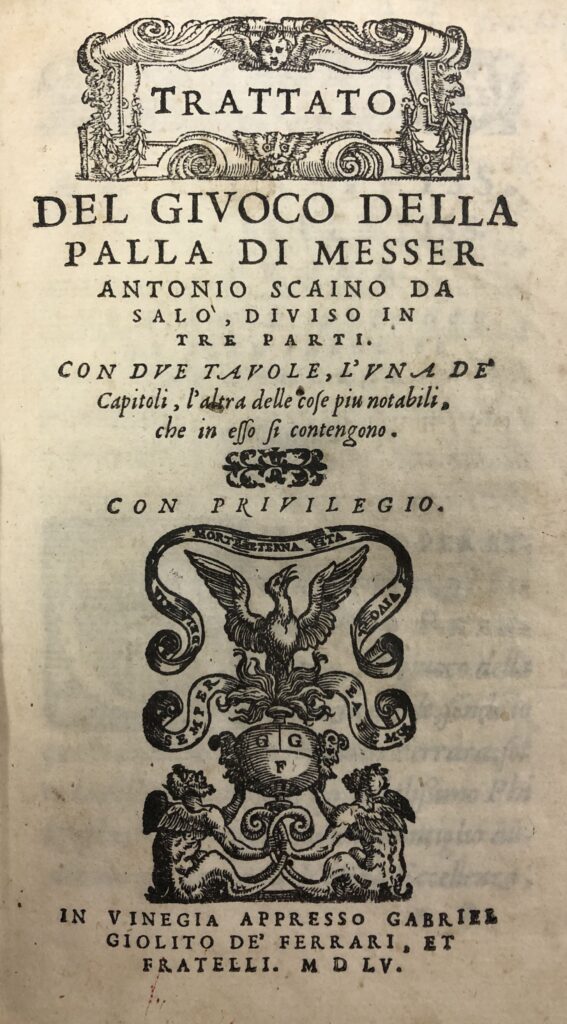
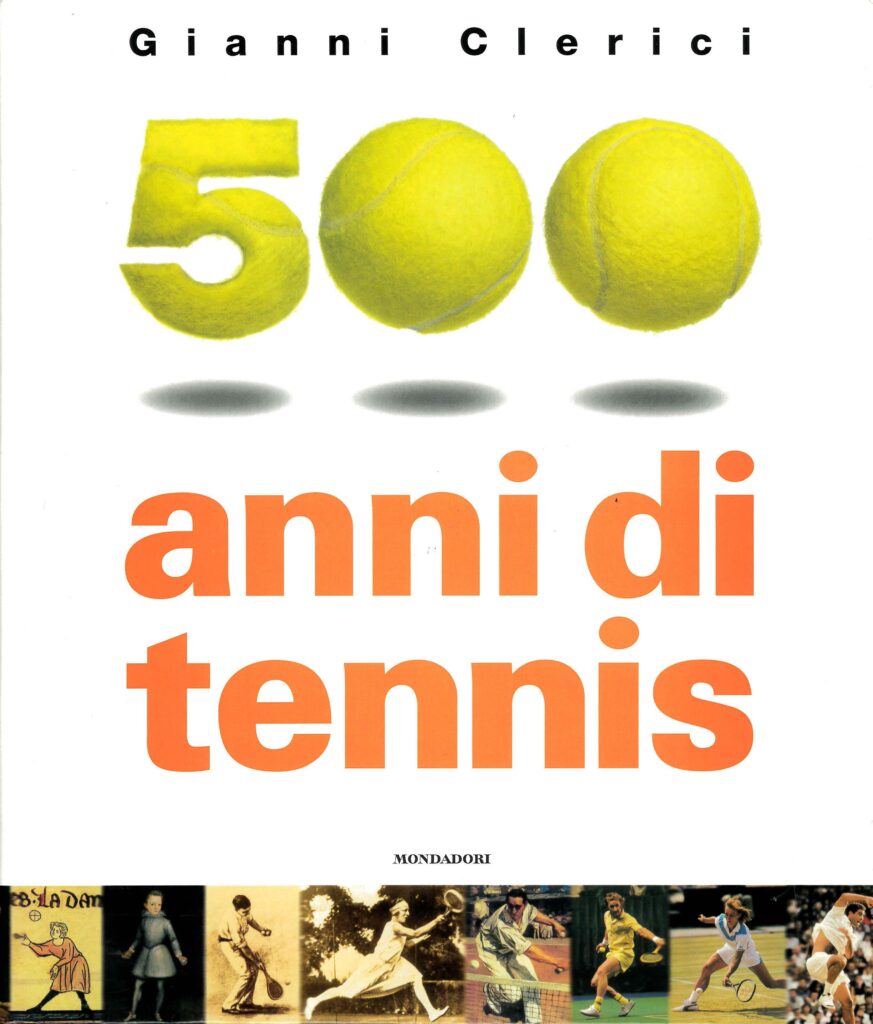
The history of tennis has always held an irresistible fascination for a passionate fan like Gianni Clerici, who has explored it in depth, studying primary sources and consulting with experts and insiders in the field. This systematic approach is already evident in his newspaper articles: when, for example, he discusses the tennis circuit and its players, every point he makes is accompanied by references to his own and others’ personal experiences and supported by broader, systemic reflections. In short, Clerici’s method is the perfect one for anyone wishing to write a universal history of tennis. One work in particular further fueled his historical interest in this sport—or rather, this “game”: the Trattato del giuoco della palla by Messer Antonio Scaino da Salò, almost unanimously considered the oldest essay on the history of tennis. The work, of which the Viganò Library preserves a valuable copy, served as the starting point for the compilation of Gianni Clerici’s masterpiece as an essayist, that 500 anni di tennis which many consider the true ‘Bible’ of the field: “I had read Scaino […], the first book on the history of tennis, dating back to 1555 and a fundamental text. To Scaino himself, my illustrious predecessor, a great Thomist philosopher, advisor to the Pope, and yet a layman, I felt it was my duty to dedicate my volume” (Il cantastorie instancabile, The Tireless Storyteller, p. 94). Written in the 1960s, while Clerici was working as the “deputy to the deputy correspondent” in London for Il Giorno and was a frequent visitor to the British Museum, the book was first published in 1974 by Mondadori. Over the years, it has been reprinted and updated several times, as well as translated in the United States, the United Kingdom, France, Germany, Spain, and Japan.
An exclusive club
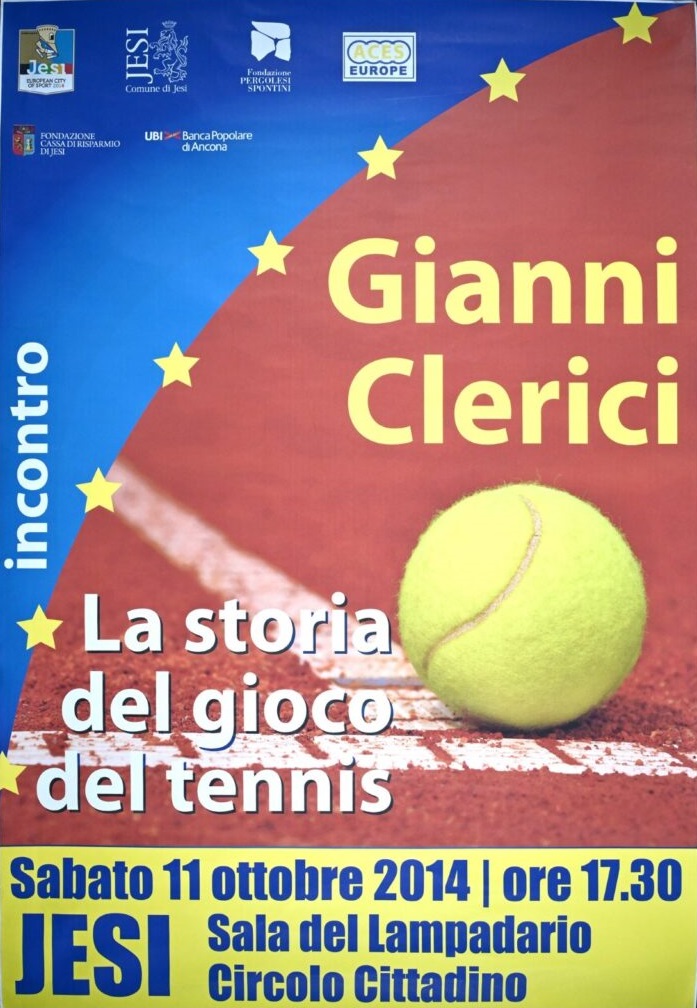
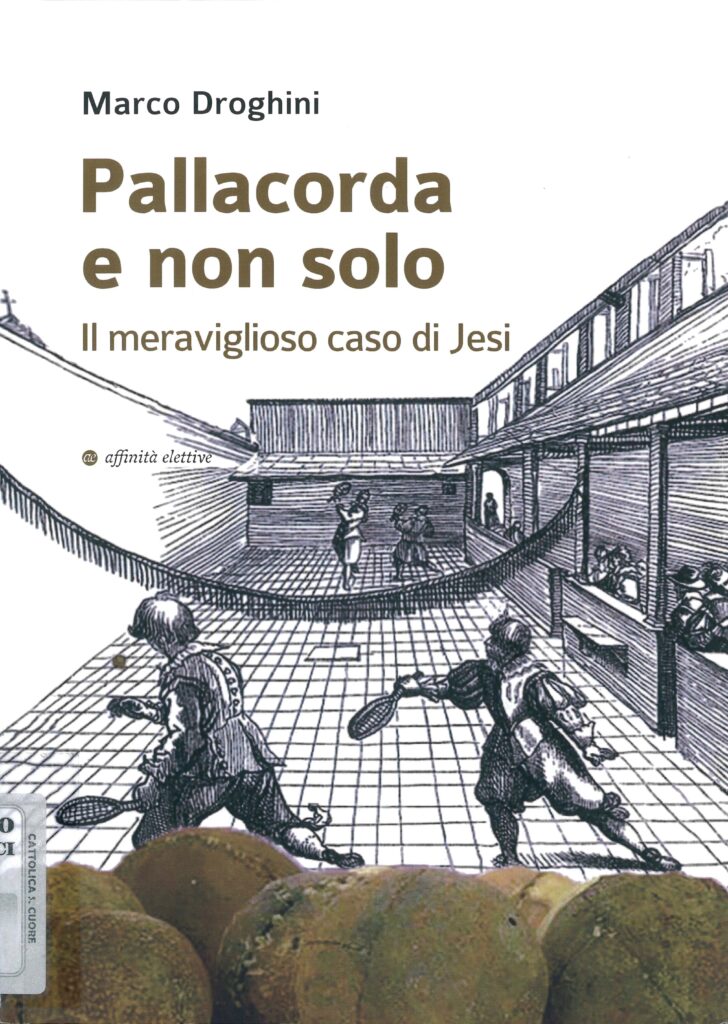
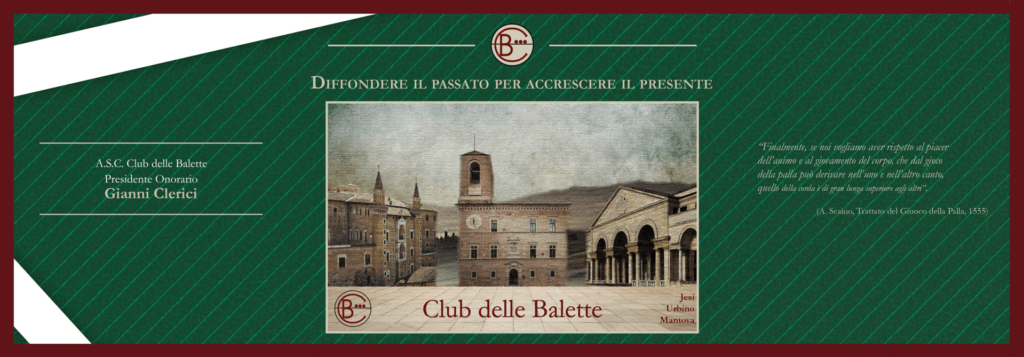
As mentioned, Clerici’s research has focused for years on the origins of tennis and its predecessors. One of these, the late-medieval “pallacorda,” has been identified as the direct predecessor of modern tennis, due to similarities in equipment and rules. Widely played in Renaissance Italy, as evidenced by Scaino’s treatise—who played it at the Este court in Ferrara— pallacorda was played using small, padded, and stitched leather balls, which were initially struck with the palm of the hand (hence the French name jeu de paume) and then, over the years, with the aid of arm guards, sticks, and finally rackets. Well, during the last century, some of these leather balls were discovered in Italy, sparking studies and research to reconstruct their history. The first discovery dates back to 1936 when, during the restoration of the well at the Palazzo della Signoria in Jesi, nine mysterious balls came to light. In 1989 in Mantua, during work at Palazzo Te, three unknown spheres were discovered among the debris of an attic; in 2006, however, the restoration of the Basilica Palatina of Santa Barbara led to the discovery of three more finds, very well preserved, including one specimen even decorated with floral motifs. Urbino is also home to several discoveries, one of which was found in the storage areas of the National Gallery of the Marche. The turning point, however, came in 2013, when, in a newspaper article, Gianni Clerici linked the Mantua spheres to the so-called “balette” used during the Renaissance. This insight served as the basis for connecting the finds from Jesi and Urbino to the same topic, thereby creating a veritable serial site linked to pallacorda. In 2014, Clerici attended the conference “La storia del gioco del tennis” (The History of Tennis) in Jesi, during which he called for the establishment of a club dedicated to studying the origins of ball games in Italy and promoting their history: five years later, in 2019, this hope became a reality with the founding in Jesi of the Club delle Balette, a cultural association of which Gianni Clerici was elected honorary president.