



“Er Francia” shines in Paris: Nicola Pietrangeli becomes Slam champion
Gianni Clerici was perhaps the world’s foremost expert on Nicola Pietrangeli—so much so that he even refused to write a biography of him, as he himself claimed. He knew him so well that he could dissect every single technical move that came from the skilled hands of that tennis prodigy, Nicola. There he was, Gianni, always there, ever since a sixteen-year-old Nick, at Tennis Parioli, had blown him away with a couple of backhand passing shots that already foreshadowed his brilliant future. The boys in Rome at the time, given the French accent he’d carried with him from his Tunisian childhood, had nicknamed him ‘Er Francia’.
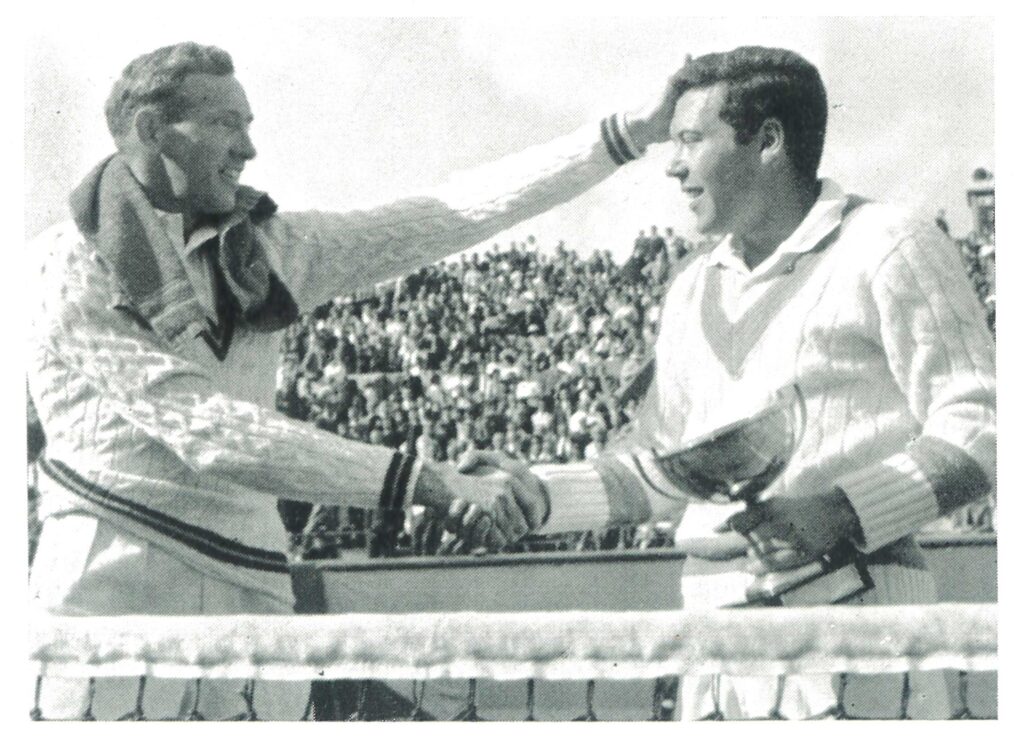
Gianni knew him very well; yet, when his moment of glory arrived—on Saturday, May 30, 1959, the day he defeated South African Ian Vermaak to lift the Roland Garros trophy into the sunny Parisian sky—Gianni was not in the stands. Clerici would later explain his absence in a 2013 interview with La Repubblica marking Pietrangeli’s 80th birthday: “Just think, as a young correspondent for Il Giorno, my beloved editor, Italo Pietra, didn’t consider the trip important,” during which Pietrangeli would go on to secure “a victory against the little-known South African Vermaak, whose serve-and-volley game had been overwhelmed by Nicola’s passing shots.”
Paris, May 30, 1959, Roland Garros Final: Nicola Pietrangeli – Ian Vermaak 3-6; 6-3; 6-4; 6-1
As striking as it may be, this gap in the Clerici archives allows us to view the story of that triumph—the first Grand Slam title ever won by an Italian—from a different perspective: that of the issues of Il Tennis Italiano, the leading tennis magazine in Italy at the time, and Tennis de France, its French counterpart. Starting with the latter, we can briefly analyze the stylistic choices of the two periodicals.
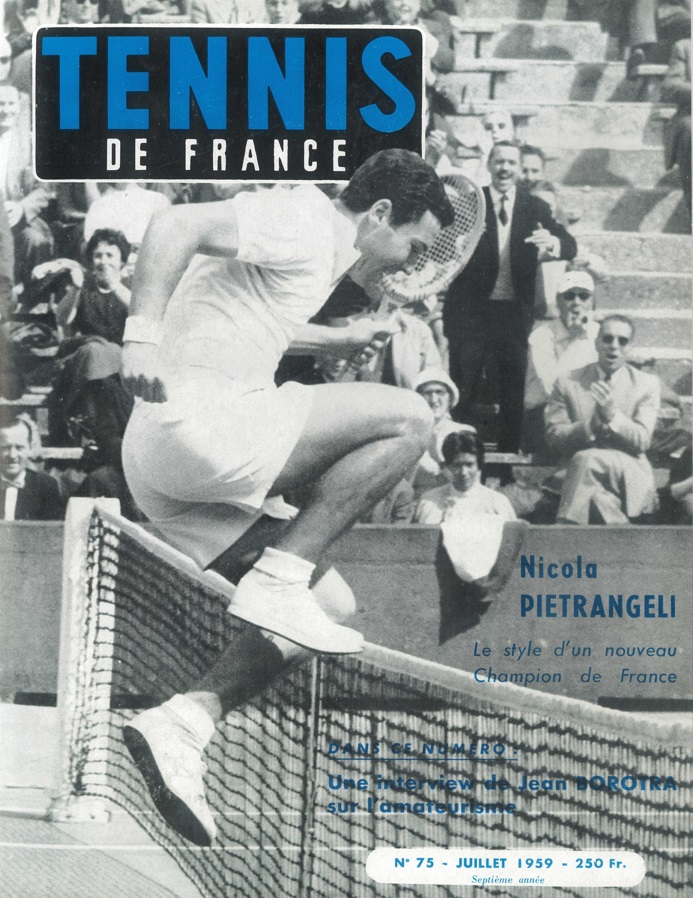
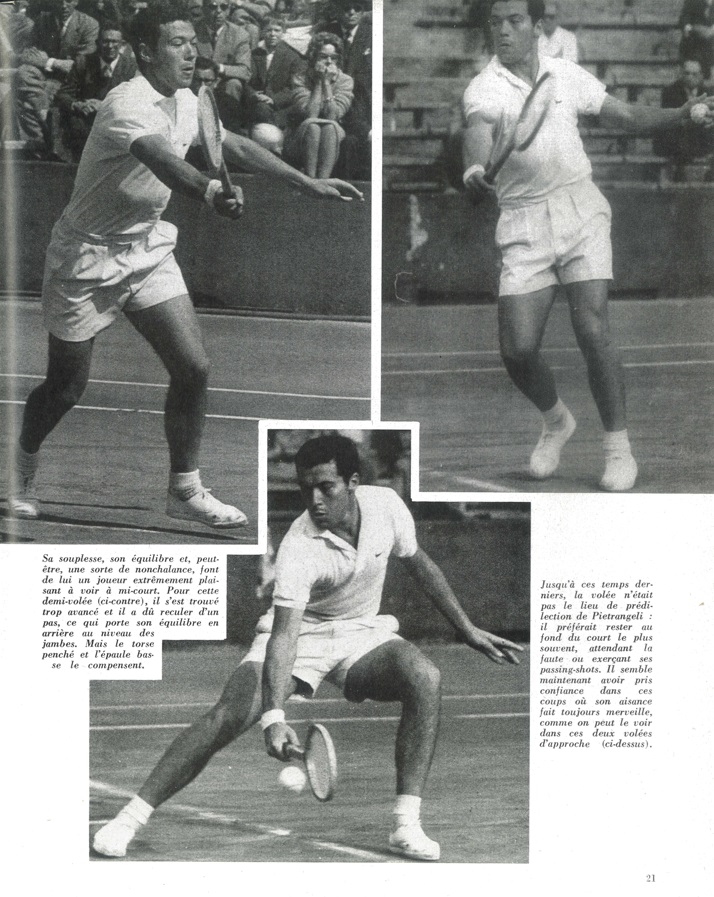
First of all, Tennis de France dedicated the cover of its July 1959 issue to the Tunis native, featuring a photo of Pietrangeli leaping over the net—a gesture that symbolized his crossing the physical and symbolic boundary separating him from his opponent—before congratulating Vermaak, the standout player of the Paris tournament. This iconic leap, far from ordinary, was the last in a series of moves that had made Pietrangeli immensely popular in France, regardless of his origins: so highly regarded, in fact, that the first article dedicated to him, written by Henri Gault (who later became famous for his restaurant guides), hailed him as “Fantaisiste – Brillant – Follement doué et charmant” (whimsical – brilliant – extremely talented and charming).
The following article, written by the magazine’s editor-in-chief, Gil de Kermadec (whom Clerici had no hesitation in describing as a genius), was a splendid tribute to Pietrangeli’s playing style, described in a detailed “technical study” titled “Le style Pietrangeli,” accompanied by a very precise set of photographs and captions. The Italian’s tennis is described here as “de classe internationale,” above all because “sa souplesse, son équilibre et, peut-être, une sorte de nonchalance, font de lui un joueur extrêmement plaisant à voir” (his agility, his balance, and, perhaps, a certain nonchalance make him an extremely enjoyable player to watch).
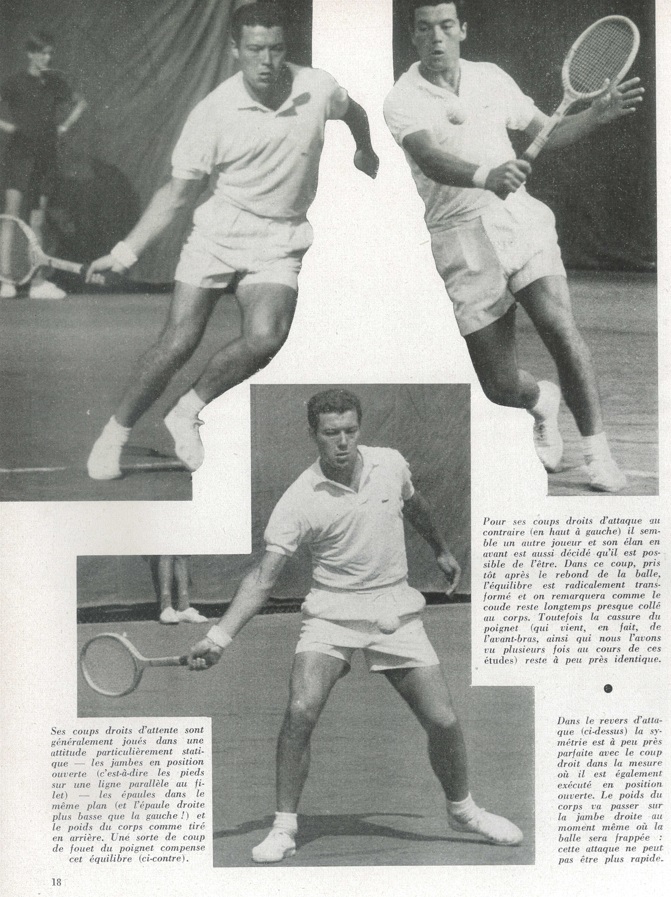
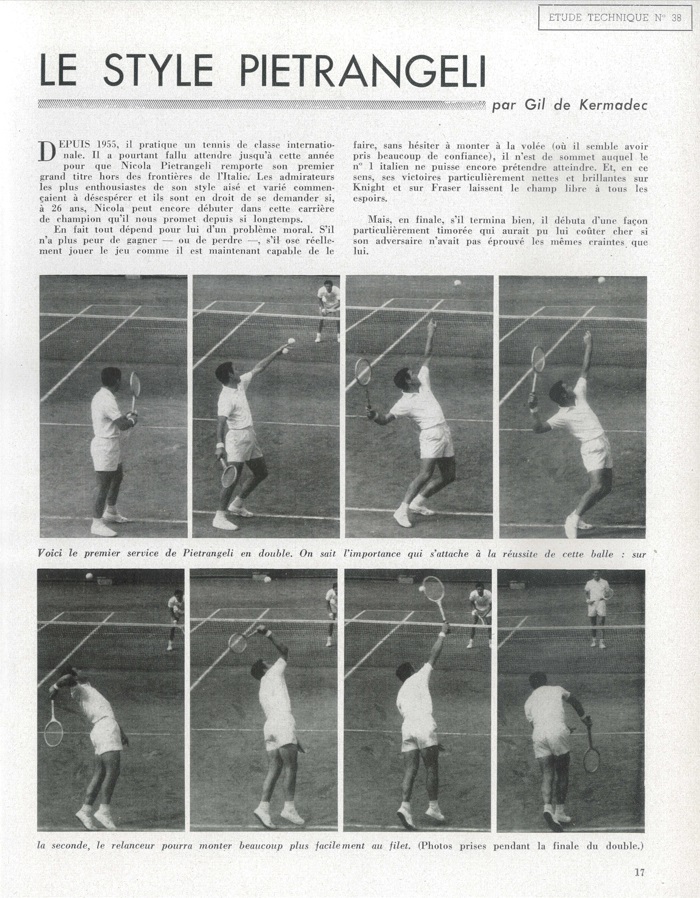
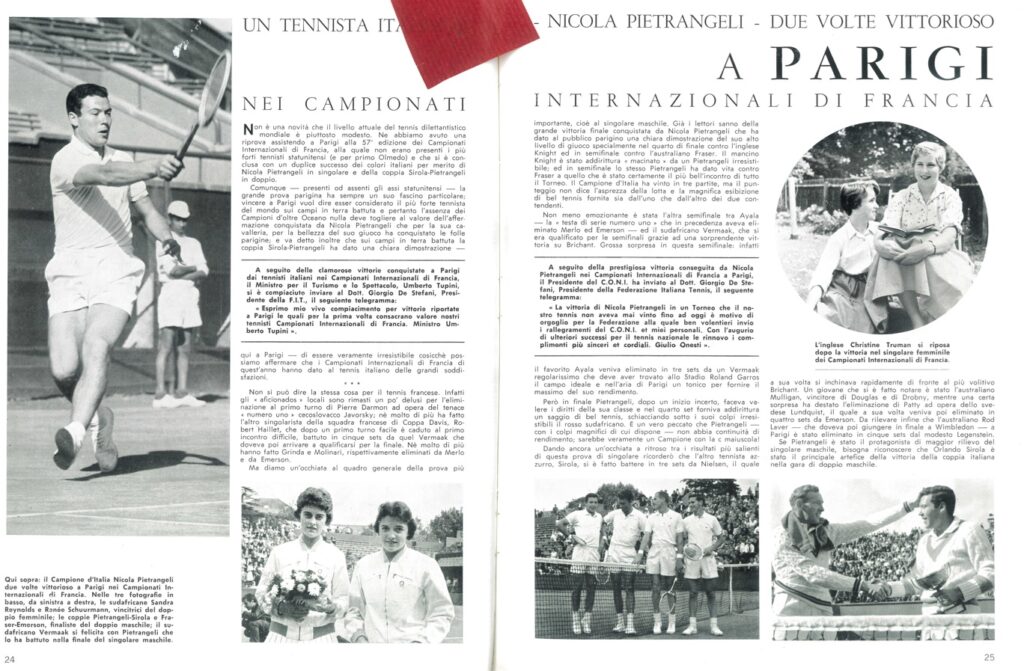
Turning to Il Tennis Italiano, in its July–August 1959 issue, the focus shifted to the exceptional achievements of Pietrangeli, who had “won twice in Paris,” both in singles and in doubles with Orlando Sirola. Paradoxically, despite Italy’s triumph, the tone wasn’t all that laudatory, if the opening of Chantal Kuntz’s report read as follows:
It is no novelty that the current level of amateur tennis worldwide is rather modest. This was proven once again by attending the 57th edition of the French International Championships in Paris, which did not feature the strongest American players (notably Olmedo).
The critique was soon softened by the clarification that “the absence of the overseas champions does not detract from the value of Nicola Pietrangeli’s achievement, who with his chivalry and beautiful game conquered the Parisian crowds.”
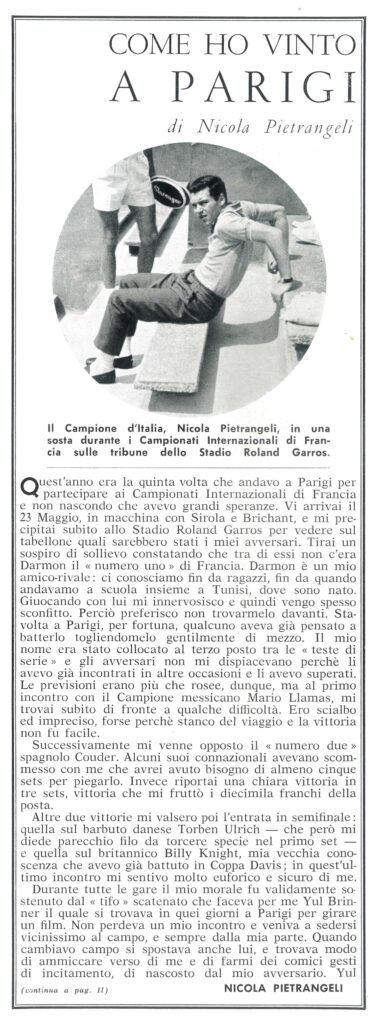
Finally, there is an interesting special feature titled “How I Won Paris,” written by Pietrangeli himself, which included, among other things, an amusing anecdote about the post-tournament celebrations:
The celebrations for my title cost me all my prize money. Before the Championships, I had promised some friends that if I won, they would be my guests for a dinner of caviar and champagne. Well, they all remembered, those fine folks; fifteen showed up on Sunday evening. At the ‘Crazy Horse,’ where I am a regular, the owner treated us; but later, at the ‘Club de l’Étoile,’ I had to pay. The caviar consumed wasn’t much, but the champagne flowed like water. Sirola, who hadn’t bet anything, paid for only one bottle.