



Let the Sunshine (Double) in
Jannik Sinner’s pursuit of the long-coveted ATP world number one ranking—still held by his arch-rival Carlos Alcaraz—has recently shifted into high gear. This surge is thanks to the Italian’s back-to-back victories in the Masters 1000 tournaments of Indian Wells (California) and Miami (Florida), which earned him a massive haul of 2,000 points, nearly the equivalent of a Grand Slam title.
Jannik’s ‘Stars and Stripes’ double (with victories over Medvedev and Lehečka, respectively) did more than just close the gap on the Spaniard; it allowed the Azzurro to join the elite group of players who have achieved the so-called ‘Sunshine Double’—winning both American tournaments in the same season. His seven predecessors are certainly no ordinary names:

Jim Courier
1991
Michael Chang
1992
Pete Sampras
1994

Marcelo Ríos
1998
Andre Agassi
2001

Roger Federer
2005; 2006; 2017

Novak Djokovic
2011; 2014; 2015; 2016

Jannik Sinner
2026
Speaking of the race for the top spot, the Sunshine Double proved decisive in 1998. On the hard courts of Key Biscayne (Miami), a relentless Marcelo Ríos—a Chilean tennis player who was atypical, to say the least, in both technique and on-court conduct—defeated the home favorite Andre Agassi in straight sets. This victory secured his ascent to the summit of the ATP rankings, a position previously held by another American champion, Pete Sampras.
Ríos thus became the first South American to hold the world number one spot since the introduction of the computerized rankings in 1973 (since then, only Brazil’s Gustavo Kuerten has achieved the same feat, between 2000 and 2001). Naturally, the event did not escape the radar of our own Gianni Clerici, who provided his characteristically colorful account of the match. The article, accompanied by a perfectly chosen photo of the Chilean sticking out his tongue, appeared in the Monday, March 30, 1998 edition of La Repubblica:
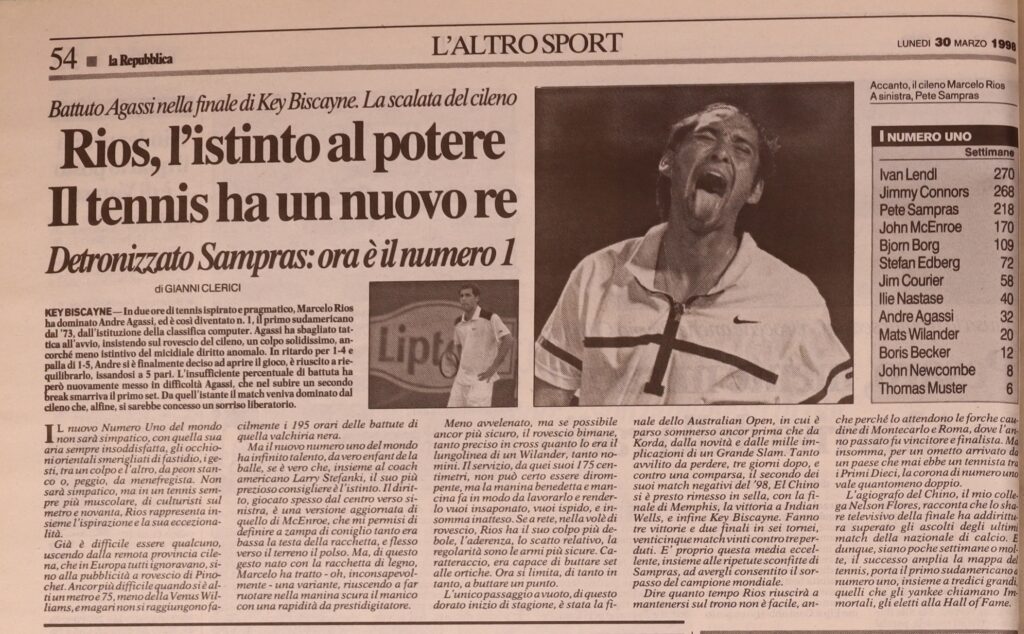
It is worth quoting a few passages from the article, just to give an idea of what kind of player Marcelo Ríos was—one who was certainly not unwelcome to Clerici:
The new World Number One may not be likable, with that perpetually dissatisfied air of his, those oriental eyes frosted with annoyance, and his gestures between shots reminiscent of a weary peon or, worse, a man who simply doesn’t care. He may not be likable, but in a tennis world that is increasingly muscular—filled with bodybuilders standing six-foot-three—Ríos represents both inspiration and its exceptionality. […]
The new world number one possesses infinite talent, a true enfant de la balle, if it is true that, alongside his American coach Larry Stefanski, his most precious advisor is instinct. The forehand, often played from the center toward the left, is an updated version of McEnroe’s, which I took the liberty of defining as a ‘rabbit’s foot’ because the racket head was so low and the wrist so flexed toward the ground. But from this gesture, born in the era of wooden rackets, Marcelo has derived—oh, unconsciously—a variation, managing to rotate the handle in his small, dark hand with the speed of a conjurer. […]
His serve, coming from those 175 centimeters of his, certainly cannot be explosive; however, that blessed left hand ensures it is worked to be either ‘soapy’ or ‘bristly’—in short, unexpected. […] The Chino’s hagiographer, my colleague Nelson Flores, notes that the television viewership for the final even surpassed the ratings of the national football team’s latest matches.