



While medals are raining down for the “Azzurri” athletes in Milano-Cortina—already reaching a tally of 9 after just one weekend of competition—let’s see how Riccardo Plattner handled a few too many snowflakes. Plattner, the chairman of the downhill skiers at the 1968 Grenoble Games, had to make a crucial decision on February 9th. We will do so by reading the account provided by Gianni Clerici:
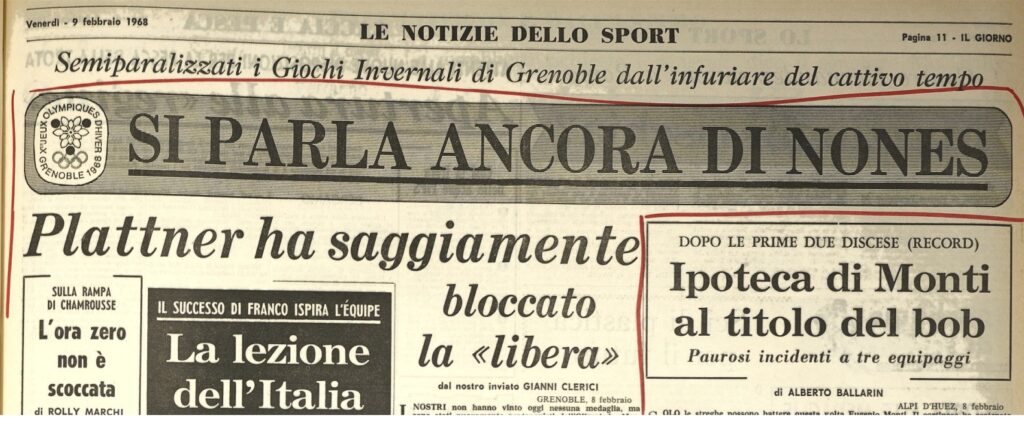
Our athletes didn’t win any medals today, but they were once again the protagonists of the Olympics. While 40,000 spectators camped out on the slopes of Chamrousse waiting for the downhill race, conversations about Nones were everywhere. Meanwhile, in the fir-wood hut used to protect skiers from the wind at the top of the course, Riccardo Plattner, the chairman of the downhill skiers, found himself facing one of the most difficult decisions of his life: the potential suspension of the race depended, in fact, on him.
I had found Plattner at the top of the course at 9:00, shrouded in clouds of wind and snow as if he were a deity: he stood perfectly upright, with that refined air derived from his profession as a hotelier and his high regard for his mission as a director. Dignified, yes, but frozen—so much so that I immediately offered him some of the food I have started carrying with me, after realizing that the much-praised organization can force an unprepared journalist into fasting, and perhaps even hibernation.
lattner didn’t have the heart to refuse the offer: he took a bite of an apple and then, looking very tense, assured me that he would not hesitate to postpone the race if necessary. I certainly didn’t envy him: and I wasn’t so sure of his determination when I announced that I would ski down the course despite the ban, without receiving any threat in response.
I then skied down, amid gusts of wind that would have stopped Fogler’s 85 kilos, passing through the poor “Cacciatori delle Alpi” who had been sideslipping since seven in the morning, shaving the snow with their aluminum short-skis.
When I let myself go at a slightly higher speed to escape one of their officers who wanted to drive me away, I also had the chance to realize that the snow conditions varied so much that it was impossible to follow the pre-established racing lines.
So I stopped, left the track, and merged with the 40,000 people who were climbing on foot or on skis, armed with poles, ice axes, snowshoes, folding chairs, transistors, and even a portable television. I stationed myself near that providential screen, and I had the chance to listen to the usual outpouring of biographical data about the downhillers, as well as many comments regarding the various possibilities of starting or suspending the race.
At a certain point, the commentator ran out of things to say and began talking about Nones as well. He repeated, in summary, the avalanche of news that all of us poured over readers or viewers yesterday. Nones appeared by turns disguised as a baker, a more or less underdeveloped mountain man, a representative of Latin or Ladin-speaking peoples, Mediterranean and Alpine, the fiancé of a Scandinavian girlfriend, a customs officer or professional, a cyclist, a cyclo-cross runner, and infinite other things.
I listened, I reflected, and I told myself that while all these reports were accurate, they perhaps only managed to provide a patched-together image of Franco—one far from the authentic man. Suddenly, I remembered a postcard I received last summer depicting the green shore of a Finnish lake. On the back was my address, my name preceded by “Esq. Dr.”, and beneath it Nones’ signature; simple like him, very clear, anything but clumsy—a signature preceded by a sentence thanking me for a tennis racket I had managed to have sent to him by a craftsman from Val d’Intelvi, someone who still makes wooden skis by hand.
So, while everyone waited for the speed kings, the television stations of half the world were still talking about him. Hearing his name, accented on the second syllable in the French style, I thought about how not one of the major racket manufacturers had been willing to send him that inexpensive piece of equipment, surely thinking that the unknown skier wouldn’t be able to offer them any publicity in return.
Meanwhile, Franco Nones was being interviewed, photographed, and pestered to such an extent that he couldn’t even manage to take a nap, after a nearly sleepless night spent dealing with the emotions and representative duties that followed his gold medal win.
Franco had only one moment of respite during the visit from his role model and friend, Sixten Jernberg, who had advised him—with a simplicity equaled only by his wisdom—to take a solitary ski run in the woods to find himself again. The announcer’s voice, followed by the crowd’s whistles, called me back to the reality of the downhill race.
Plattner had decided that skiing down—that is, racing for an Olympic medal—in that fog would have been too risky, and above all, unfair to the competitors less favored by the gods of the winds. I would have liked to shake his hand for a decision as courageous as it was unpopular. We really aren’t making a bad impression at all in these parts.