



On the occasion of the Milan-Cortina 2026 Winter Olympics, we relive the Grenoble 1968 edition by publishing in full some memorable articles by Gianni Clerici exactly as they appeared in the columns of Il Giorno. Today, February 10, we read about the triumph of the heavy favorite, Jean-Claude Killy:
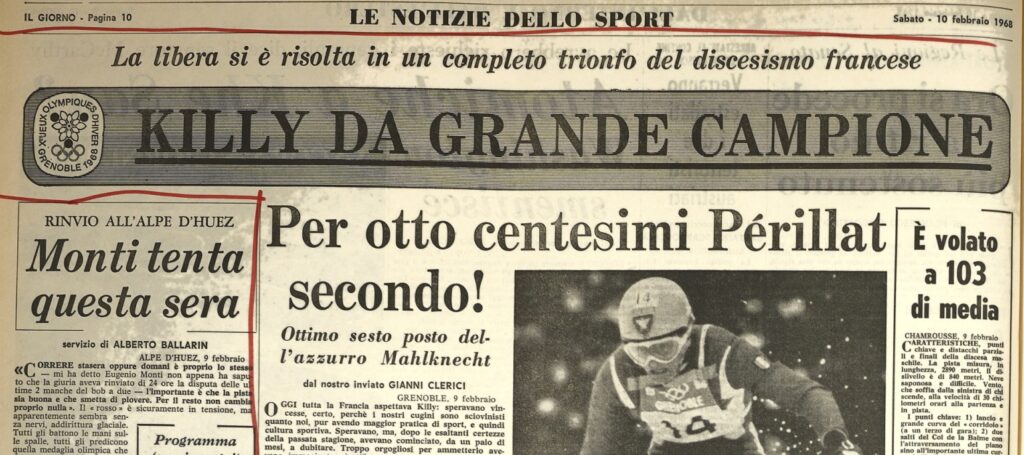
Today, all of France was waiting for Killy: they hoped he would win, of course, because our cousins are as chauvinistic as we are, despite having more sporting experience and, therefore, sporting culture. They hoped, but after the exhilarating certainties of last season, they had begun to doubt for a couple of months. Too proud to admit it, they had dreamt up justifications of fascinating yet fragile logic throughout the winter. Gradually, Killy’s defeats had been attributed to poor form, to fresh snow suited to the Swiss, to scandals provoked by spiteful Austrians, and finally to the threat of suspension for professionalism.
All of these were certainly excellent reasons, but, at the same time, they were alibis for the fan and for his informants in the press and television. They served the people, allowing them to carry on cradled by a fine Alpine superiority complex, but they were of no use to Killy—a man intelligent enough to admit the truth to himself. Killy knew perfectly well that he was worth more than his opponents, while at the same time being in worse form than, for example, Nenning. He also knew that if he lost at home, in an Olympics willed by the General [De Gaulle] on a track prepared for the French, nothing would be forgiven him.
Under such disastrous conditions, Killy truly proved himself to be a great man even before being a great champion. He knew how to conquer himself; he knew how to downplay the drama thickening around him. The simple, common acts of sleep and human relationships became difficult trials, and Killy managed to overcome them with the same ease he displayed today during almost the entire downhill. Jean-Claude had one small initial uncertainty that put him slightly behind Périllat at the Gobbe del Gallo, two-thirds of the way through the course.
From that point, before my admiring eyes, Killy gave a demonstration of skiing that silenced the roar of enthusiasm that had accompanied him since the start. He grazed two gates in cramponnage, almost as if they were slalom poles and not a passage at a hundred kilometers per hour; he anticipated the first two bumps of the Col de la Balme, flying thirty meters, yes, but canceling out the terrible effects of the second—the one that would later cause a carnage among the competitors of the second group. Then, on the long flat stretch where the Swiss are usually untouchable, Killy definitively overtook his friend Périllat and Daetwyler, skiing tucked into himself like a half-closed deckchair. In this stretch, which most had not deemed decisive during the practice runs, this ambiguous “downhill” was settled.