



Following the historic golds won by Italian athletes in the women’s doubles luge (with Andrea Vötter and Marion Oberhofer) and the men’s doubles (with Emanuel Rieder and Simon Kainzwaldner), led by the national team’s technical director and living legend of the discipline, Armin Zöggeler, let’s discover more about the feat of Erika Lechner, gold medalist at Grenoble 1968, as told by Gianni Clerici on February 16 in Il Giorno:
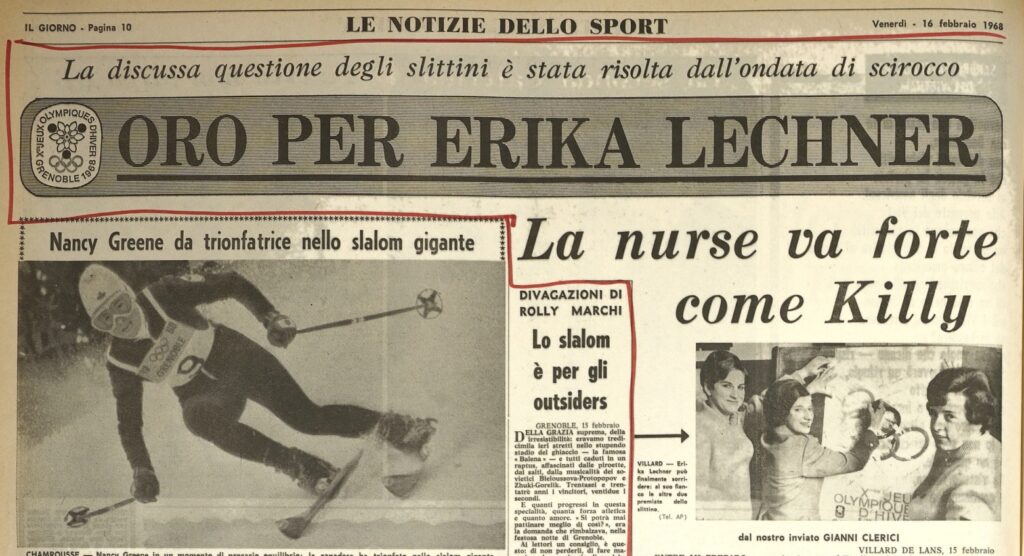
While I prepare to discover the sport of the sled, which has just given us our third medal, I see from the hotel window a black limousine with little flags. Feeling uneasy in her light-blue parade uniform and unsteady on her boot heels, Erika Lechner steps inside with a nod of grateful surprise at the driver’s attentiveness. In the car, a skilled and relentless interviewer stands ready to make her repeat what the girl has already repeated to me, and what she will soon repeat before microphones and cameras. Let’s hope Erika doesn’t get too confused and—to the interviewer’s great discomfort—start speaking German again, her mother tongue, the language of the South Tyrolean minority. Erika is, in fact, a girl from Maranza, a remote little village in the Puster Valley, a community of 500 souls made of farmsteads gravitating around a church.
Erika has seven siblings; her parents were born in 1914, peasants under the Austro-Hungarian Empire. They always believed that many arms were needed to better resist hardship and to cultivate the meager slopes where livestock find little nourishment. Erika’s parents, Papa Alois and Mamma Maria, still have a few animals; it’s no surprise that the luge gold medalist was, like almost all country folk, once a shepherdess.
At this moment, however, Erika has already been promoted to the role of “nurse”—a word she doesn’t know, unlike schwester or bambinaia. In fact, the president of her club, Durchner, kept her in his home for some time to look after the children. And I am certain that children have never been safer in a town where the sled is just about the only entertainment.
Erika began sledding naturally, like all the young people of the village, which is connected to the valley only by a cable car. She showed me, along with her brother Emil, how it is done: the torso stiffened backward, one arm tensing in the effort to steer those 19 kilos of wood and iron that, in certain stretches, exceed the speed of Killy. Sometimes the fingers lose control, and the sled bolts; then you fall backward and get very hurt, as happened Sunday to Cristina Pabst.
Since that day, Erika has been contested by her world—a world transported en masse to a small hotel in Villard-de-Lans. Her name, suddenly modified to “Erica” by many newspapers, had indeed been involved in the most surprising mystery of the Olympics: that of the runners heated by the “wicked” East Germans. The poor souls, to defend themselves, had turned it all into politics, declaring among other things that they considered Erika undeserving of the title. Suddenly, Erika was faced with questions that no longer concerned the technique of the sled, the use of the scythe, or the care of children: I heard with my own ears someone ask her what she thought of the living conditions in East Germany!
And, even more astonishingly, came the answer, pronounced while resolutely raising two eyes of the clearest blue. She believed, Erika said slowly, that life was better with us, in Italy. It was these words that freed me from the worry, from the mental reservations I had carried into the little hotel among those boys who at first glance seemed foreign, different. Finally at ease, I spent two very pleasant days in the company of young, cheerful, and polite people: together with the blacksmith Emil Lechner, the mason Mair, the farmer Graber, and the woodcarver Prinoth; with their brothers and cousins, because in the team, almost everyone is a relative.
We played scopa, drank a few glasses while eluding the supervision of Battisti—the FISI counselor whom everyone now calls the “Strumolo of the luge”—and soon I was even let in on a secret that Erika herself didn’t know: the phone calls from her boyfriend, the bobsledder Schlemmer, were coming from Grenoble, not Bressanone. A little trick to save a beautiful surprise for the girl once the medal was won.
Meanwhile, jury meetings followed one another with increasing delays, team leaders continued to meet uselessness on a track reduced to a stream, and Battisti and the West German Hartman insisted that the race be suspended at the third run and the medals awarded. This morning, around 9:00, the car bearing the presidential plates of old Brundage also made an appearance in the village. After two hours, finally, the jury decided, and Erika was an Olympic champion in a specialty little known or practiced, but very tough for a girl. To say that Erika’s victory honors both her region and our country does not seem, for once, cliché or overly rhetorical.