



United States of “Italy”
I had never seen, in a Grand Slam final, two girls sitting and chatting with a smile, as if they had just finished a club match and were sharing secrets about some trivial matter—almost as if one were asking the other what movie she was going to see a couple of hours later, or which diner she had chosen.
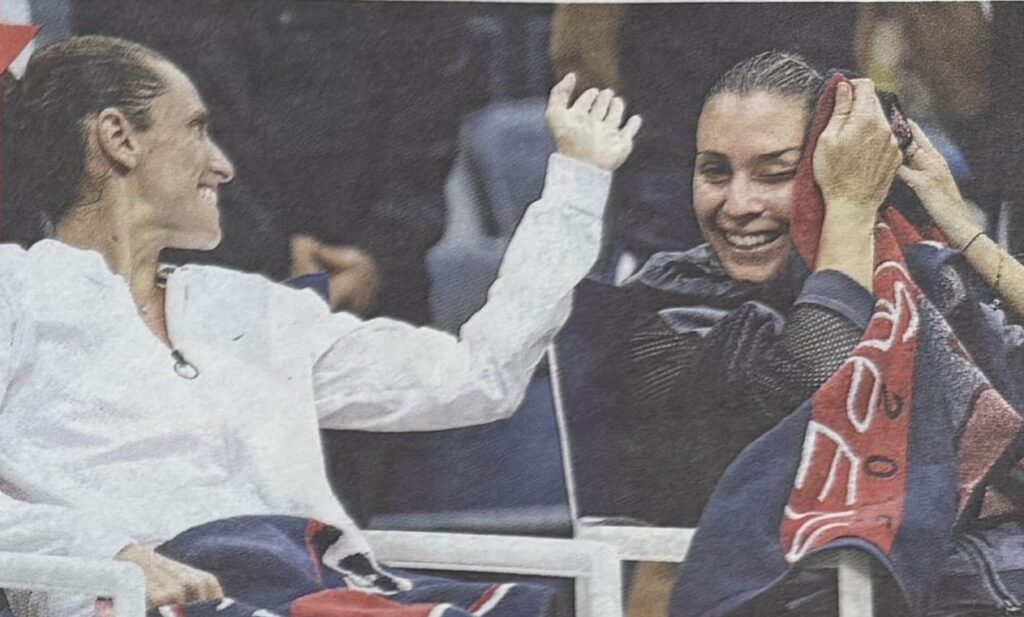
A Late Summer Night’s Dream
Imagine seeing two “carusedde” (young girls) from Salento—Flavia from Brindisi, Roberta from Taranto—stepping onto the cobalt blue concrete of the Arthur Ashe Stadium at Flushing Meadows, in the Queens borough of New York. Let’s also imagine that the US Open final is at stake, one of the most glittering tournaments in the world, the last of the season’s four Slams. Imagine what feelings they must have felt in the tunnel leading to the court, sensing on their skin the hum of twenty thousand souls waiting for the duel. Today, nearly ten years after September 12, 2015, we can relive the emotions of that night through the words of Gianni Clerici, who wrote in La Repubblica the day after the match:
The final of this Slam will remain, I hope, unforgettable for its low-key tones; it was as if nearly twenty thousand people—who had paid scalpers up to 500 dollars for tickets—weren’t even there, erased by that friendship, by the provincial character of the match. I say provincial, and I don’t mean that as a slight. The two Italian girls come from large cities, but they are still provincial cities—places where in the evening, walking down the main street, it is easier to recognize a fellow citizen than to ignore them.
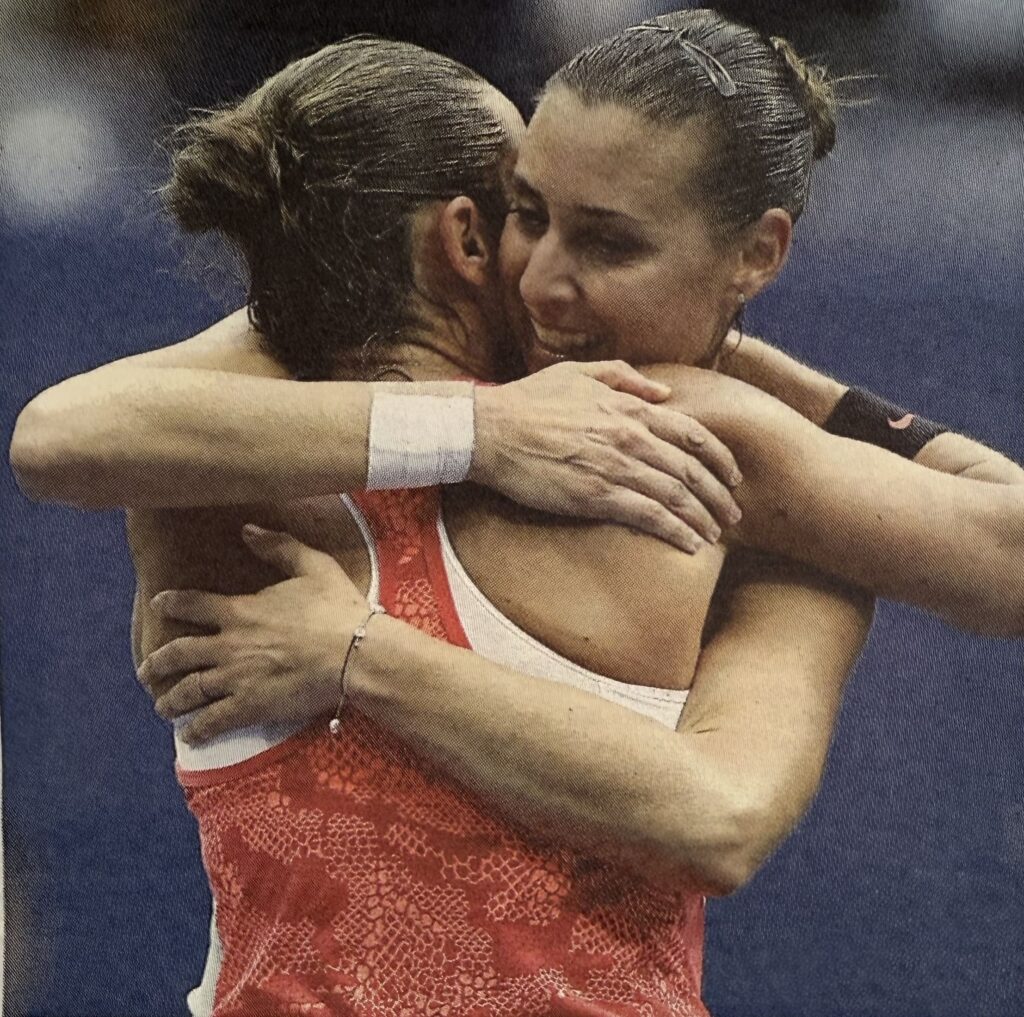
Almost Fellow Citizens
It is no coincidence that Flavia Pennetta (born ’82) and Roberta Vinci (born ’83) had known each other since they were young girls, times when they were doubles partners capable of winning the Torneo Avvenire, the Trofeo Bonfiglio, several ITF titles, and even the Junior Roland Garros. Fellow countrywomen and accomplices, one might say—so much so that they gave the Slam final a relaxed, almost surreal atmosphere given the context, worlds away from the exasperated antagonism and psychological duels of certain other matches.
What will remain, beyond the record, beyond the result, is the humanity and the friendship—something I had already admired and even pointed out in the match between Venus and Serena. Who are, I recall, sisters. No differently than Flavia and Robertina proved themselves to be friends.
Visible and Invisible
Given the nature of the dispute and the shared stage, a comparison naturally arises with the pages of Levels of the Game. In John McPhee’s book, part chronicle and part novel, the on-court confrontation between Arthur Ashe and Clark Graebner (1968 US Open semifinal) is dissected and explained, with descriptions starting from the technical and athletic gestures of the contenders and reaching the psychological component of their performance. The tennis players, both American but vastly different in social background and life paths, pour all their character differences onto the court through gestures, sighs, and words, masterfully transposed in McPhee’s narrative, which makes it a veritable treatise on the microcosm enclosed in a tennis match. If you like, this composite narrative approach can also be found in Clerici’s style; he does not limit himself to the visible aspects of the match (which he often neglects), instead descending into the hidden details and the “unsaid.” The chronicle of this all-Italian final, however, is limited to a skimpy paragraph, where one senses Gianni’s distance—certainly regretful for not having been able to see it live:
I should also comment, from a bit of a distance, on the match in its technical aspects. I would say then—as far away as I am, with television images that I know from direct experience are slightly different from real ones, just as movies are different from life—that geometry prevailed over imagination, solidity over creativity, and in short, the tennis of today over that of yesterday. Robertina did manage to come back from an initial disadvantage for which she herself was responsible, more so than Flavia, who was not yet at her peak geometric form. But once the tiebreak ended, the match was—at least for me, a professional spectator—practically over, and Robertina’s frustrated creativity had no chance of reversing its fate.
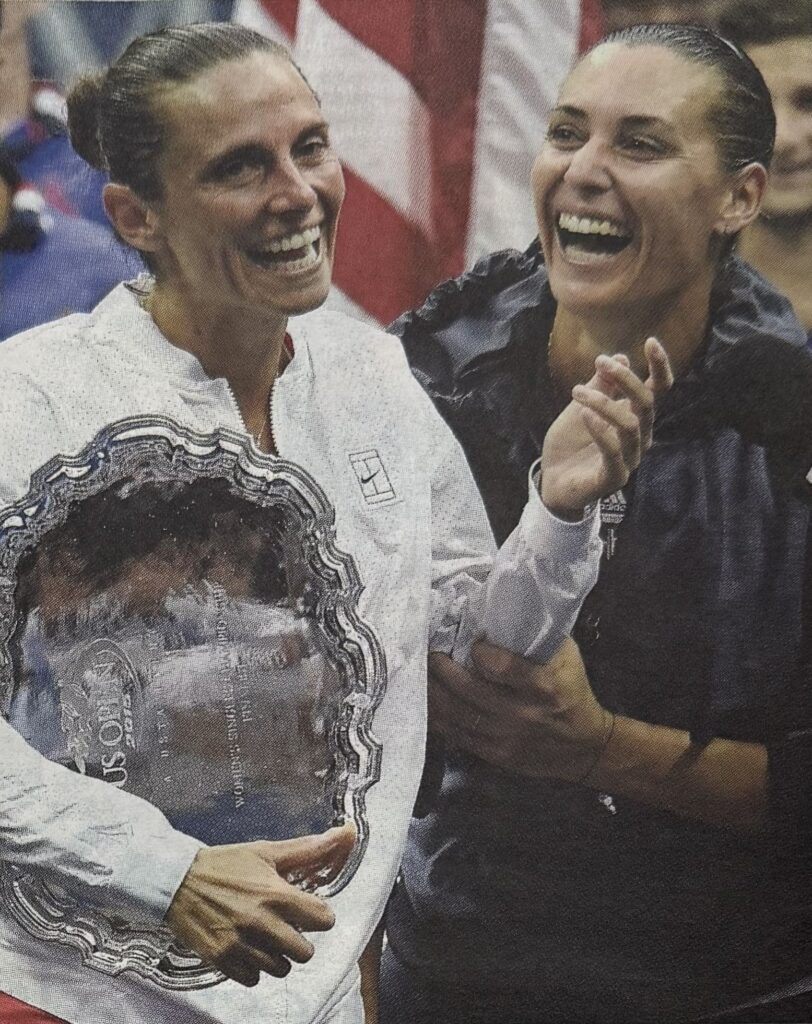
Tricolor Derby
It was Flavia Pennetta who won that final, announcing her retirement from the courts that had given her so much satisfaction at the end of the match. Just last night, in the Arthur Ashe Stadium, spectators witnessed another Italian derby. Two friends competed for a place in the semifinals: world number one Jannik Sinner and his closest Italian pursuer in the rankings, world no. 10 Lorenzo Musetti. Now that the dust has settled, one could say the score of 6-1, 6-4, 6-2 in Sinner’s favor does not do enough justice to the battle offered by Musetti. The truth, however, is that the gap is clear—so much so that Musetti himself in the post-match press conference, impressed by Sinner’s solidity and ball speed, defined the South Tyrolean’s game as “oppressive,” wishing him luck in defending the title he won in 2024. Waiting for Jannik in the semifinal is now the Canadian Félix Auger-Aliassime, a likely “appetizer” for the next chapter of the infinite Sinner-Alcaraz saga.